Real lift. No surgery. Lasts months.
PDO Thread Lift uses dissolvable surgical threads placed under the skin to physically lift sagging tissue — while simultaneously triggering collagen production that sustains the result for 12–18 months after the threads themselves dissolve.
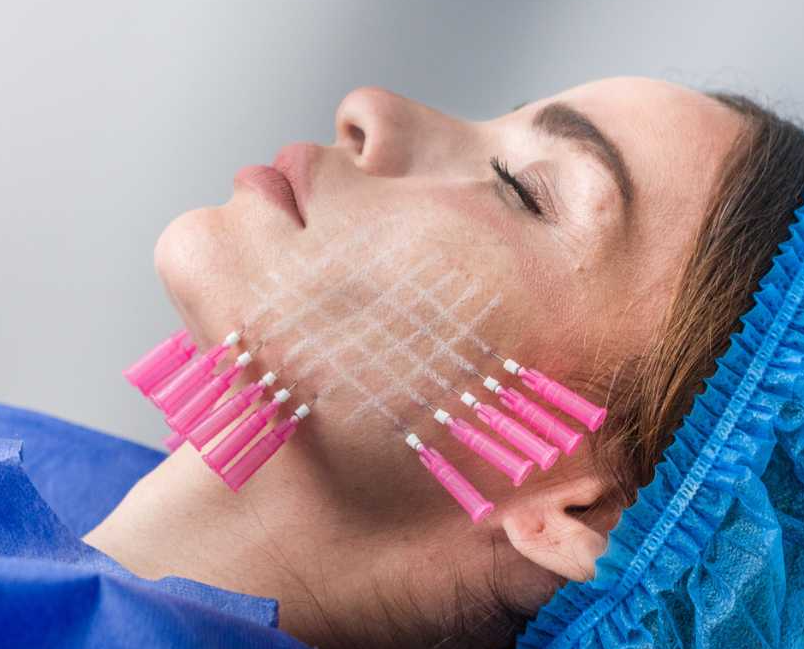
Laxity is a structural problem. PDO threads are the only non-surgical treatment that addresses it structurally.
When skin has descended due to tissue laxity — not just volume loss — no amount of filler or Botox can lift it back. Threads mechanically reposition tissue and then stimulate the collagen that holds it there.
The most common and impactful application. Barbed PDO threads anchored at the hairline or temple physically grab and lift the descended tissue of the lower face and jowls — repositioning them to a more youthful anatomical position with an immediate visible result. The collagen response along each thread's pathway sustains this lift as the threads dissolve.
The malar fat pad descends from the late 30s onward, creating the flattened midface and deepened nasolabial folds that characterize facial aging. Threads placed in the mid-cheek area lift the fat pad superiorly — restoring the convex cheek contour and reducing nasolabial fold depth as a secondary effect.
Early neck banding, platysmal laxity, and the softening of the cervicomental angle (the angle between neck and chin) respond to smooth and barbed threads placed in the neck — improving definition and reducing the appearance of early neck aging in patients who aren't yet candidates for surgical correction. The thread lift is also used on body areas beyond the face and neck — including buttocks, knees, elbows, stomach, back, arms, and legs — anywhere gravity and aging create skin laxity. The procedure on body parts takes no more than 30 minutes, same as the face.
Threads placed in the lateral brow area lift the outer brow and address the lateral hooding that develops as brow position descends with age. The effect is more substantial and longer-lasting than Botox-mediated brow lift for patients with more significant brow ptosis.
Smooth (non-barbed) PDO threads don't lift — they're placed in a mesh pattern to trigger collagen synthesis along their entire length. Used for areas where collagen stimulation and skin thickening is the goal rather than lift — commonly the under-eye area, lips, and décolletage.
Patients who've been using fillers to compensate for laxity often reach a point where adding more filler produces diminishing returns or over-volumized results. Thread lift addresses the underlying structural issue — allowing existing filler to work as it's intended (volume restoration) rather than as an imperfect substitute for lift.
If your concern is sagging or descent rather than volume loss, threads address what fillers cannot.
This distinction matters clinically. Adding volume to sagging tissue produces a fuller-looking result, not a lifted one. A physician assessment will tell you honestly which you need — and whether threads, fillers, or a combination is the right answer.
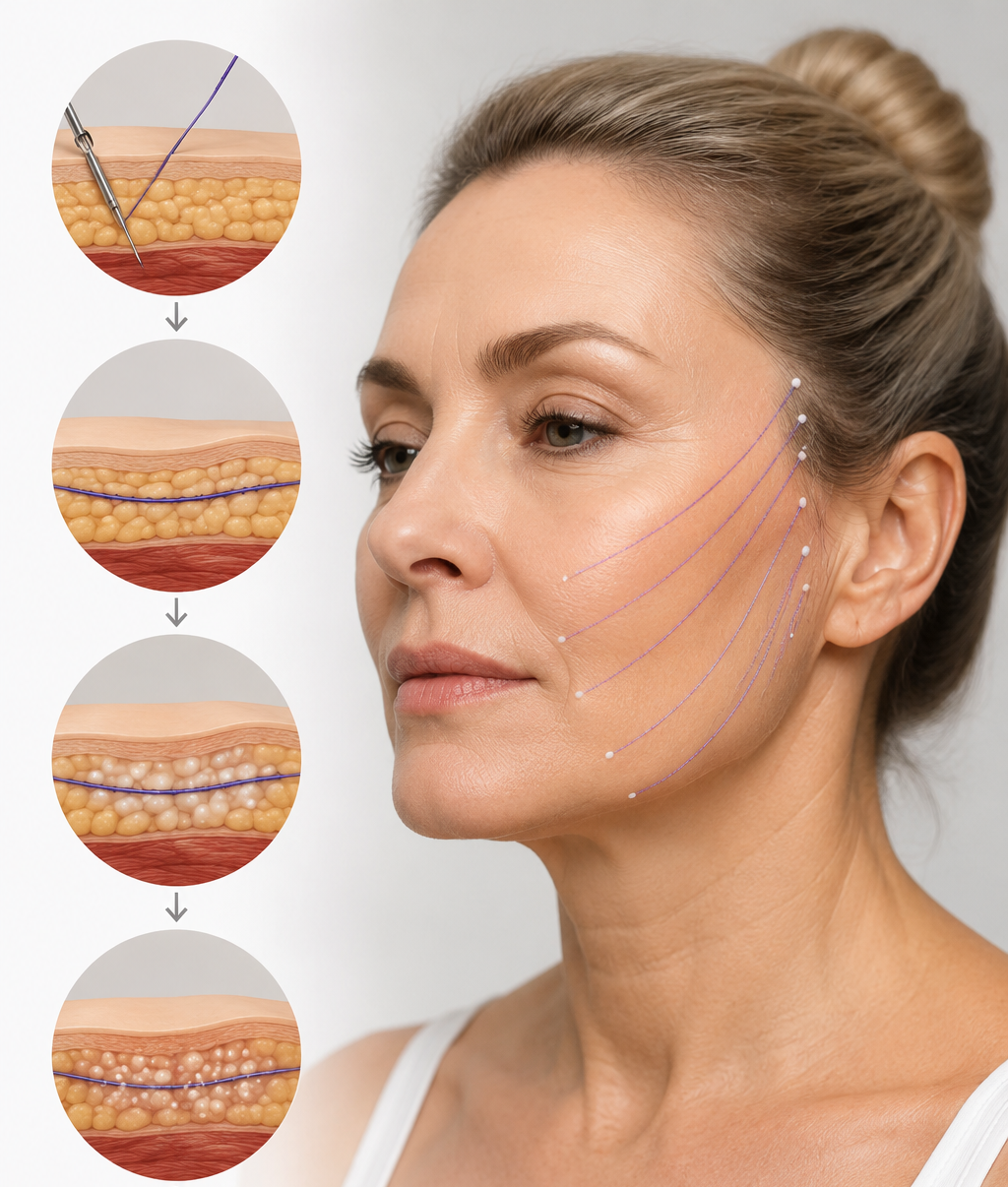
Immediate lift. Then months of your own collagen.
PDO (polydioxanone) is the same biocompatible, absorbable material used in surgical sutures for decades — with a well-established safety record. In thread lift procedures, fine needles introduce these threads under the skin in precise anatomical planes. Barbed threads have tiny anchors that catch the subcutaneous tissue and hold it in a lifted position when the thread is tensioned. Smooth threads lie in a mesh pattern and trigger collagen formation along their length.
The dual mechanism of thread lift is what distinguishes it from all other non-surgical aesthetic treatments. Phase one is immediate: the mechanical lift that occurs at the time of the procedure — visible tissue repositioning that patients see in the mirror on the day of treatment. Phase two develops over 3–6 months: as the PDO threads dissolve (typically over 6–9 months), their presence in the tissue triggers a sustained inflammatory response that stimulates fibroblast activity and new collagen synthesis along the entire length of each thread. This collagen formation continues even after the threads are fully gone.
The result is a lift that doesn't fully resolve when the threads dissolve — because the collagen formed in their pathway maintains the tissue support they initially provided mechanically. Most patients retain 60–70% of the initial lift effect at 12 months, with the full result lasting 12–18 months before a maintenance procedure becomes beneficial.
Degree and pattern of tissue descent — is it addressable non-surgically or does the degree of laxity indicate surgical correction would produce a meaningfully better outcome? Skin thickness and quality — thin skin requires different thread placement than thicker skin. Prior filler volume — over-volumized patients may need filler dissolution before threads. Medical history: anticoagulants, bleeding disorders, and active infection are contraindications. We'll give you an honest assessment of what threads can and can't achieve for your specific anatomy.
The closest non-surgical equivalent to a facelift.
PDO Thread Lift is the only non-surgical treatment that addresses tissue laxity structurally — physically repositioning descended tissue rather than compensating for it with volume. The evidence for its efficacy and safety in properly selected patients is well-established.
From consultation to a lifted result.
We assess your degree of laxity, skin quality, and goals. We'll tell you honestly what's achievable non-surgically and what would require surgery — and design a realistic treatment plan accordingly. No pressure, no over-promising.
The entry points, thread vectors, and placement depths are mapped on your face. We determine how many threads are appropriate, which type (barbed for lift, smooth for collagen), and where each one goes. This planning is as important as the procedure itself.
Local anesthetic is administered at entry points. Fine needles introduce the threads along mapped vectors. You may feel mild pressure during tensioning. Mild swelling and bruising for 3–5 days. Most patients resume normal activities within 1 week.
Results are immediate and continue to improve over 3 months as the collagen response develops. Follow-up at 4–6 weeks to assess the result. Maintenance procedures at 12–18 months to refresh the lift as collagen gradually remodels.
Medicine that
gets you.
Thread lift is one of the most technique-dependent procedures in aesthetic medicine. The vector of each thread, the depth of placement, and the number of threads all determine whether the result is natural — or not.
Physician-Only Procedure
PDO Thread Lift requires detailed knowledge of facial anatomy — specifically the fat compartments, retaining ligaments, and vascular anatomy that determine where threads can and cannot be safely placed. This is a physician-level procedure, not an aesthetician one. PDO thread lift is an FDA-approved procedure with a well-established safety record.
Honest Assessment of What's Achievable
Not every patient with laxity is a thread lift candidate. Significant ptosis often requires surgery to achieve a satisfying result. We'll tell you this honestly at consultation — recommending threads only for patients where the non-surgical approach can deliver a result they'll be genuinely happy with.
The Right Combination Strategy
Thread lift is most powerful as part of a comprehensive approach — paired with fillers for volume, Botox for dynamics, and PRF for skin quality. A lifted face that also has restored volume, softened expression lines, and improved skin texture looks decades better than a lifted face alone.
Post-Procedure Support
We schedule a follow-up at 4–6 weeks and are available to address any concerns during the recovery period. Mild asymmetry can sometimes be adjusted early. We don't perform thread lift and then send patients to manage alone.
Real patients.
Real results.
Everything you
want to know.
The lift you want.
Without the surgery.
A free consultation with our physician. An honest assessment of what thread lift can achieve for your anatomy. And a clear plan with realistic expectations — before anything else.