You still look like you. Just a more rested version of it.
Botox, Dysport, and dermal fillers — administered by board-certified physicians who understand facial anatomy. The goal is never to look different. It's to look like yourself on a very good day.

Expression lines are a biology problem. Not a willpower problem.
Wrinkles form where muscles repeat the same movements thousands of times — and where volume naturally depletes with age. Understanding which type you have determines exactly which treatment is right for you.
Lines that appear when you smile, frown, or raise your eyebrows — and over time, remain visible even at rest. Forehead lines, frown lines (the 11s), and crow's feet. Caused by repeated muscle contraction.
Lines visible whether or not you're making an expression — particularly around the mouth, cheeks, and jowls. Develop as collagen depletes and skin loses structural support.
Cheeks that have flattened. Under-eye hollows that create a perpetually tired appearance. Lips that have thinned. Volume loss happens naturally from your mid-30s onward as fat pads shift and shrink.
The lines that run from nose to mouth corner, and from mouth corner to chin. These deepen as midface volume depletes, causing skin to descend. Respond well to filler placed directly and upstream.
Fine vertical lines above the upper lip and reduction in lip volume and definition. Addressable with small amounts of filler to restore the border and precise, conservative augmentation.
Horizontal neck lines and crepey texture on the décolletage. Botox can relax platysma bands; filler addresses surface lines; PRP and PRF stimulate collagen in the skin itself.
The difference between a good result and an obvious one is clinical knowledge.
Our physicians understand facial anatomy at a level that determines where, how much, and in which plane to place product. That's what produces results that look like you — not like a treatment.
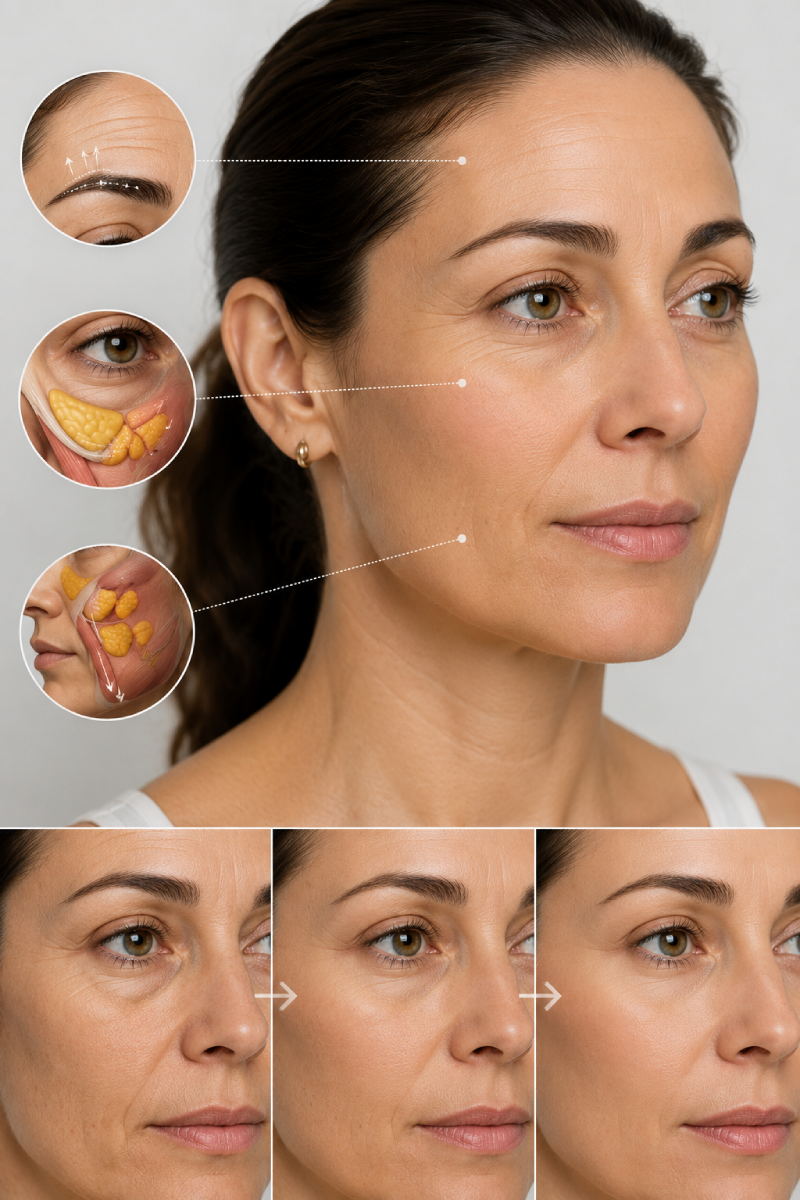
Aging changes two separate things. The right treatment depends on which one you're addressing.
Dynamic wrinkles are the result of cumulative muscle activity. The orbicularis oculi (crow's feet), frontalis (forehead), and corrugator supercilii (frown lines) contract thousands of times per day. Over years, the repeated folding of skin creates grooves that persist even when muscles are at rest. Neuromodulators work by temporarily reducing the strength of those contractions — not eliminating expression, just softening the force behind it.
Volume loss is a separate process. From the mid-30s onward, the fat compartments of the face — particularly the malar fat pad, the sub-orbicularis oculi fat (SOOF), and the buccal fat — begin to shift downward and reduce in volume. This changes the contour and geometry of the face: cheeks flatten, the under-eye area hollows, and the lower face widens relative to the midface. Dermal fillers using hyaluronic acid restore this structural volume — lifting, sculpting, and smoothing simultaneously.
The most effective outcomes for patients with both dynamic lines and volume loss come from treating both simultaneously — neuromodulators for the muscle-driven lines, fillers for the structural changes. This combination approach is more effective than either treatment alone, and with an expert physician, uses less product than treating each area independently because of how lift in one area reduces strain in adjacent areas.
Muscle activity patterns · Volume distribution and fat pad position · Skin quality and elasticity · Facial proportion and symmetry · Your goals and how you want to look. We never inject without understanding the full picture of your face — and your goals.
Two treatments. One addresses muscles. One restores structure.
Botox and Dysport target the muscles behind dynamic expression lines. Dermal fillers restore the volume and architecture that has changed with age. Your physician will assess your face and goals before recommending which treatment — or combination — is right for you.
Not sure which one? We'll guide you after reviewing your bloodwork.
The world's most trusted neuromodulators — FDA-approved injectable proteins that temporarily relax the muscles responsible for dynamic expression lines. Clinically equivalent with minor differences in spread and onset; your physician will recommend the right choice.
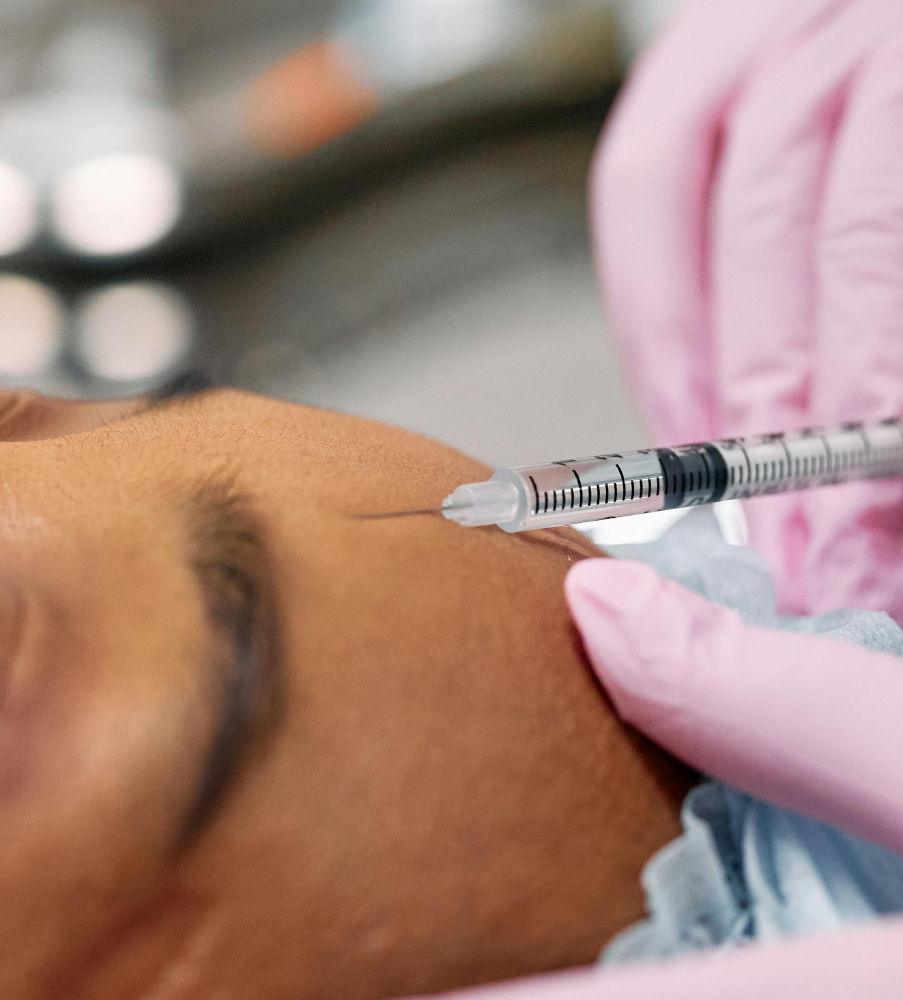
Hyaluronic acid-based injectable fillers that restore volume, smooth deep lines, define facial contours, and provide structural lift. Biocompatible, reversible with hyaluronidase, and entirely natural-looking when placed correctly.
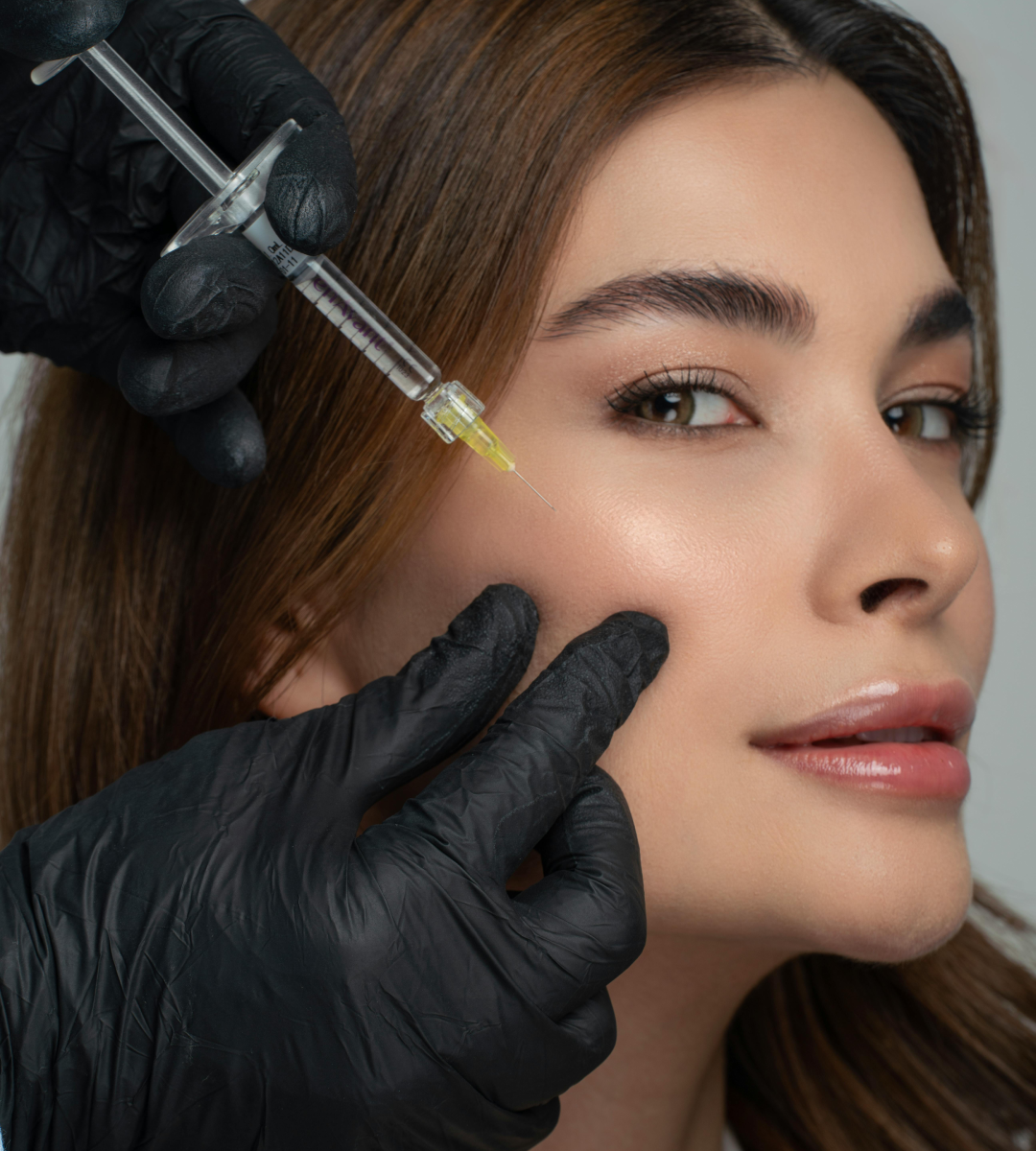
Botox / Dysport vs. Dermal Fillers — how to choose.
Your physician will guide you. This table helps you understand the distinction before your consultation.
| Feature | Botox / Dysport ★ | Dermal Fillers |
|---|---|---|
| What it treats | Dynamic (movement) lines | Volume loss, deep static lines |
| Mechanism | Relaxes muscle contractions | Restores structural volume |
| Common areas | Forehead, frown, crow's feet | Cheeks, lips, under eyes, folds |
| Results visible | 5–14 days post-injection | Immediately after treatment |
| Duration | 3–4 months | 12–18 months (area dependent) |
| Reversible | Wears off naturally | Yes — with hyaluronidase |
| Downtime | None | Minor swelling 1–3 days |
| Can be combined | ✓ Yes — most patients do | ✓ Yes — with Botox/Dysport |
Botox is the single most performed aesthetic treatment in the world. And has been for 20+ years.
Botulinum toxin type A has the longest clinical track record of any aesthetic treatment — first approved for medical use in the 1980s, and for cosmetic use in 2002. Dermal fillers using hyaluronic acid have a similarly strong evidence base for volume restoration and facial contouring when properly administered.
From consultation to results — typically in a single visit.
Your physician reviews your concerns, examines your facial anatomy, and discusses your goals. We show you what results are realistic for your specific face — no over-promising, no pressure.
We map the treatment areas — which muscles to relax, where to place volume, how much product is appropriate. We discuss the results you'll see and what to expect in the days following.
Botox and Dysport injections take 15–30 minutes. Filler sessions typically 30–60 minutes. Topical anesthetic is applied beforehand. Most patients return to normal activity immediately.
A 2-week follow-up after Botox to assess results and address any touch-up. Maintenance at 3–4 months for neuromodulators; 12–18 months for fillers. We track your results over time.
Medicine that
gets you.
Over 15 years delivering aesthetic results in Las Vegas — with board-certified physicians who prioritize natural outcomes and patient safety above all.
Board-certified physician injectors
Our injectors are physicians with deep clinical knowledge of facial anatomy — not aestheticians or nurses following a protocol.
Less is more philosophy
We'd rather under-treat and top up at two weeks than over-treat at the first session. The goal is always natural.
Personalized treatment mapping
We never inject without a full facial assessment. Product placement, volume, and depth are all determined by your unique anatomy.
Confidential & comfortable
A private, clinical environment where you can speak openly about your aesthetic goals without judgment.
Real patients.
Natural results.
Everything you
want to know.
The most natural result starts with
the most expert approach.
A free consultation with our physician. A clear treatment plan with honest expectations. And a result designed around your face — not a template.